Lighting Installation in Kansas City, MO
Most of the lighting work we do in Kansas City is in houses that were wired before the fixtures people want now existed. The bungalows through Brookside and Waldo, the four-squares in Hyde Park, the shirtwaists on the Northeast bluffs — beautiful houses, plaster ceilings, and almost never a box where you want the light.
Why the old houses fight you
Two things stop a lighting job in a pre-war Kansas City house. The first is the ceiling: plaster and lath does not take a remodel can the way drywall does, and cutting it badly cracks a ceiling well beyond the hole. The second is the switch box. The 2011 code was the first to require a neutral at most switch locations, and nothing in the old neighborhoods was wired to that. Without a neutral, most smart dimmers simply will not work — which is why people buy them, install them, and find the lights buzzing or flickering. We check for it before you order fixtures, not after.
What lighting work costs in Kansas City
Most contractors won’t tell you what sets the price until they’re standing in your house. Here’s what we look at, and which parts actually move the number.
| Job | Relative cost | What drives it |
|---|---|---|
| Fixture swap, box already there | Baseline | Chandelier, pendant, or vanity light onto an existing, properly rated box. |
| Ceiling fan where a light was | Slightly higher | A light box is not a fan box. Fans need a box rated to carry the weight and the wobble, which usually means getting above the ceiling. |
| Recessed cans, attic above | Moderate | Open attic access is the cheap version. We cut from below and wire from above. |
| Recessed cans, no access | Higher | Second floors and plaster ceilings mean fishing the run blind and patching after. |
| New switch or added switch leg | Higher | Wall has to be fished. Plaster and diagonal bracing both slow this down. |
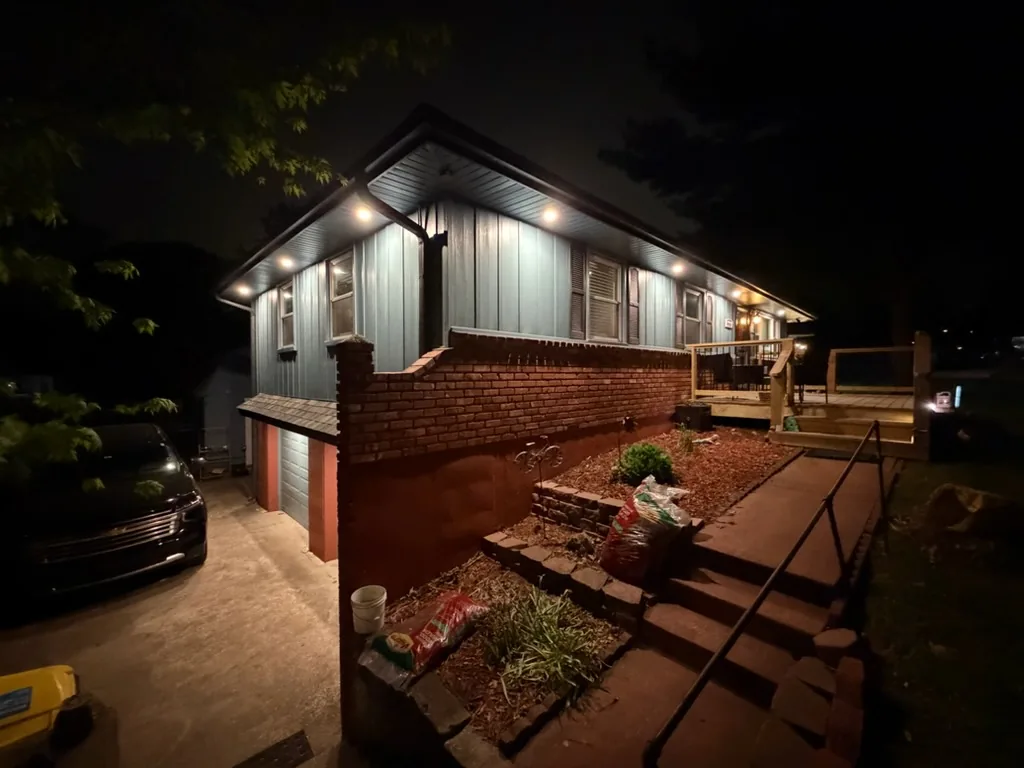
| Soffit downlighting | Per run | Exterior circuit, weather-resistant GFCI protection, and spacing set so the fixtures read as even from the street. |
| Landscape uplighting | Per run | Low-voltage: a transformer on its own exterior circuit, then buried runs out to the fixtures. |
Access is what moves the number, not the fixture. The same six cans are a straightforward day with an attic above them and a considerably longer one under a plaster ceiling on a second floor. We look first and give a flat price before anything starts.
What to Expect
Walk the rooms
We go through what you want lit and what you want it to feel like, and say plainly where the house will make that expensive.
Check the boxes and the circuits
Is there a neutral at the switch? Is the ceiling box rated for a fan? Is the circuit already carrying more than it should? These decide the plan.
Permit where the work needs one
New circuits get a permit and an inspection. A like-for-like fixture swap does not.
Install
Cans cut and wired, fixtures hung, exterior runs on weather-resistant GFCI protection, low-voltage transformers on their own circuit.
Match the dimmers, then walk it at night
Dimmers get matched to the actual fixtures so nothing buzzes or flickers, and exterior work gets looked at after dark — which is the only time you can judge it.
Questions We Get in Kansas City
Why won't my smart dimmer work in my old Kansas City house?
Almost always because there is no neutral wire in the switch box. A neutral at most switch locations was first required in the 2011 code, and the older neighborhoods were wired long before that. Some dimmers are built to run without one, and where they will not do the job we run a neutral to the switch.
Can you put recessed lighting in a plaster ceiling?
Yes, and it is the part worth planning. Plaster and lath does not cut like drywall and it cracks past the hole if it is rushed. What it costs depends mostly on whether there is attic space above to wire from.
Can I hang a ceiling fan where my light is now?
Only if the box is rated for it, and a standard light box is not. A fan box is braced to carry the weight plus the movement. Swapping one for the other usually means getting above the ceiling, so it is worth checking before the fan is delivered.
Do you do outdoor and landscape lighting?
Yes — soffit downlighting, uplighting on trees and stone, and switched exterior circuits. Outdoor work is weather-resistant GFCI protected, and low-voltage landscape runs get a transformer on its own circuit. We come back after dark to aim it, because that is the only time you can actually see what you have.
Do I need a permit to add lighting?
For new circuits, yes, and we pull it and meet the inspector. Changing a fixture on a box that is already there does not need one.
Ready to Get Started?
Call, text, or request a free quote online — we typically respond within one business day.