Radon Mitigation in Kansas City, MO
Kansas City spans Clay and Jackson counties, and the EPA places both in Zone 1 — its highest radon category, where predicted average indoor levels exceed the 4.0 pCi/L action threshold. Whichever side of the river you're on, the underlying geology puts you in the same bracket.
One city, a century of foundations
Kansas City's housing stock runs from 1920s brick bungalows in Brookside and Waldo to converted lofts in the River Market to new construction up in the Northland. That range matters for radon, because how the gas gets in depends entirely on what the house sits on — a century-old block foundation with a dirt-floor section leaks differently than a modern poured slab. There's no single system that fits the whole city, which is why we diagnose before quoting.
What radon mitigation costs in Kansas City
Most contractors won’t tell you what sets the price until they’re standing in your house. Here’s what we look at, and which parts actually move the number.
| Job | Relative cost | What drives it |
|---|---|---|
| Standard basement system | Baseline | Single suction point, exterior fan, vented above the roofline. |
| Older block foundation | Higher | Common in Brookside and Waldo. Block walls are hollow and often need sealing before suction works properly. |
| Crawlspace encapsulation | Highest | Sealed membrane plus vent system. More labor than a slab install. |
| Post-mitigation retest | Included | We retest once the system is running. That's the only proof it worked. |
Age and foundation type drive most of the variation — a 1920s block foundation is a different job from a 2015 poured slab. Flat price after we've seen it.
What to Expect
Test first
Short-term test kits are cheap and widely available. Test before you spend anything on mitigation.
Diagnostic visit
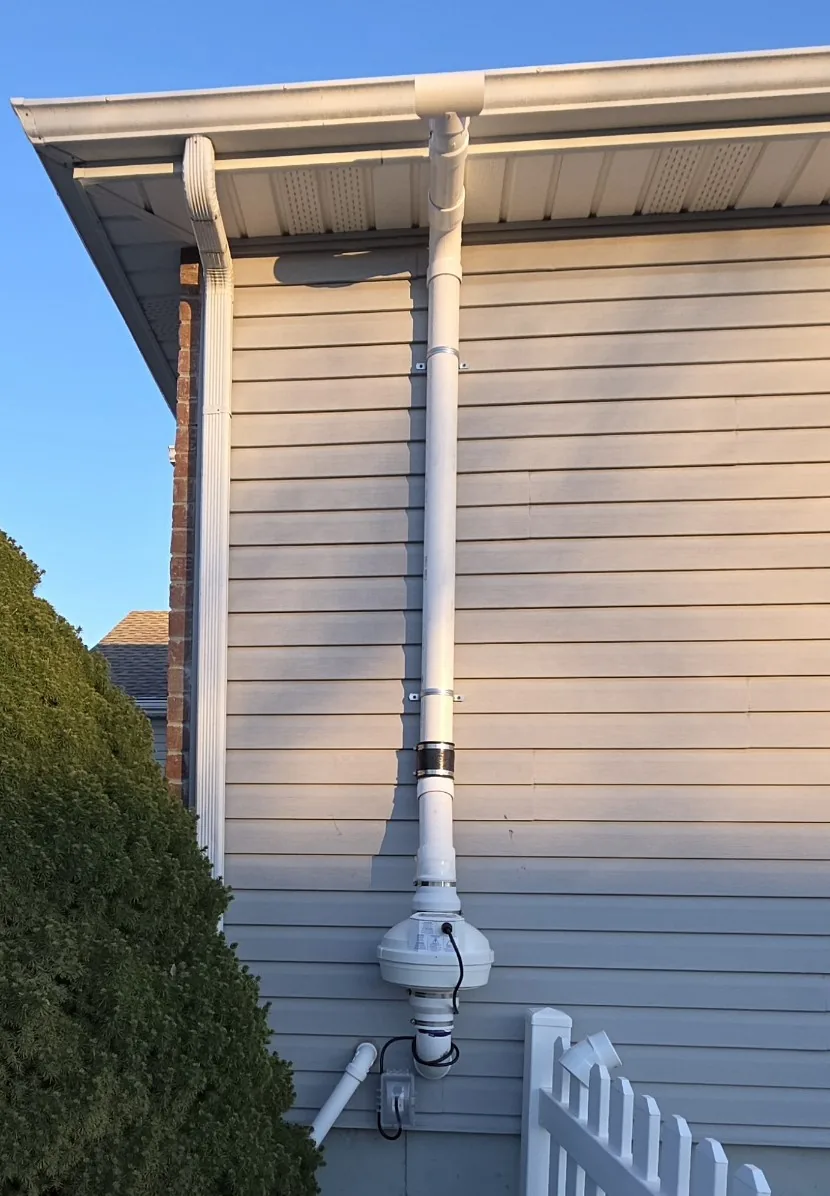
We assess the foundation, locate the suction point, and plan a vent route that exits above the roofline and clear of windows.
Permit
Pulled through the City of Kansas City.
Install
Core the slab, run sealed PVC, mount the fan outside on a dedicated weatherproof circuit, fit a manometer.
Retest
A follow-up test confirms the level dropped below the action threshold.
Questions We Get in Kansas City
How much does radon mitigation cost in Kansas City?
Age and foundation type account for most of the difference. A poured basement slab with one suction point is the straightforward version. Older block foundations in Brookside and Waldo cost more, because hollow block walls usually need sealing before suction works properly. Crawlspaces are the most involved of the three.
Is radon a problem in Kansas City?
Both Clay and Jackson counties are EPA Zone 1, the highest of three categories, with predicted average indoor levels above the 4.0 pCi/L action level. Your individual house still needs testing — zone maps predict, they don't measure.
Do I need this if my basement is unfinished?
Radon doesn't care whether the basement is finished. It collects in the lowest enclosed space and moves upward through the house. An unfinished basement you rarely enter can still raise levels on the floors above.
Why hire an electrician for radon mitigation?
The system is a continuously running fan on a dedicated exterior circuit. We're licensed electricians who also install radon systems, so the wiring is done properly and one company stands behind the whole job.
How soon can you get out here?
We're based in the Northland at 64157, so Kansas City jobs are usually same-week. Call or text and we'll confirm timing.
Ready to Get Started?
Call, text, or request a free quote online — we typically respond within one business day.