Landscape and Outdoor Lighting Service
Outdoor lighting is the one electrical job people see every night. Done well it is invisible: you notice the house, the trees and the path, not the fixtures. Done badly you notice the glare from the neighbour’s yard.
Aimed after dark, or not aimed at all
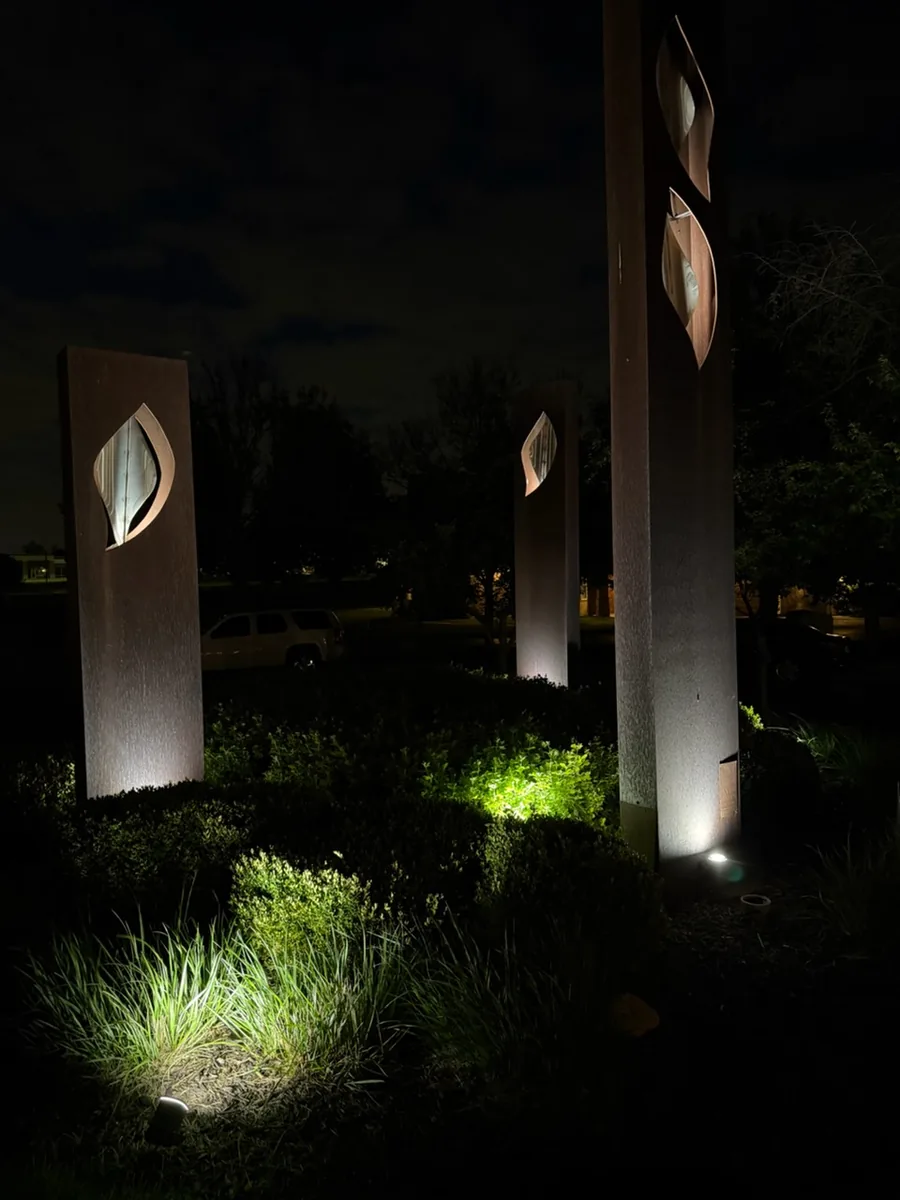
Most landscape lighting is installed in the afternoon and never looked at again at night. That is why so much of it glares into windows, lights the mulch instead of the tree, and leaves the path it was meant to light in shadow. Aiming is a separate visit to the job, after sunset, and it is what separates lighting that looks designed from lighting that looks like fixtures.
The other half is the part nobody sees: the transformer sized with headroom, the runs buried at the right depth, connections that survive a Kansas City winter, and a timer or photocell that does not need resetting every season.
What moves the price of outdoor lighting
We do not publish a dollar figure we cannot stand behind. What we can tell you is which parts of the job move the number.
| Job | Relative cost | What drives it |
|---|---|---|
| Replacing existing fixtures | Baseline | New heads on a system that already has a transformer and runs in the ground. |
| A new low-voltage system | Priced by the run | Transformer, buried runs and fixtures. The trenching and the distance decide it, not the fixture count. |
| Soffit or security lighting | Higher | Line voltage, so it needs a circuit, a switch or a photocell, and work at height. |
| Repairs to an existing system | Lowest | A dead run, a failed transformer or corroded connections. Usually one fault taking out several fixtures. |
| Holiday or seasonal outlets | Low | A switched, weatherproof outlet at the soffit line so nobody runs a cord out a window in December. |
We walk the yard before quoting, then give a flat price. Aiming happens after dark, and it is included.
What to Expect
Walk it in daylight, plan it for night
What you want lit, what you want hidden, and where people actually walk.
Size the transformer and the runs
With headroom, so the system can grow later without starting again.
Bury and connect properly
Runs at depth, connections that survive winter and the mower.
Come back after dark
Every fixture aimed while it is running. That is the visit that makes it look designed.
Questions We Get
How much does landscape lighting cost?
The fixtures are the smaller part. What moves the number is the length of the runs, the trenching, and the transformer the system needs. A small path lighting job and a whole-house uplighting design are different orders of magnitude, and we quote flat after walking the yard.
Half my landscape lights stopped working. What is wrong?
Usually one fault rather than several: a damaged run, a corroded connection, or a transformer that has failed or tripped. Water gets into the cheap push-on connectors that come with kits. We find the fault rather than replacing the run of fixtures.
Is low voltage better than line voltage?
For path, garden and uplighting, yes: it is safer to work around, easier to extend, and the fixtures are smaller. Soffit lighting, security lighting and floodlights are usually line voltage, on their own circuit with a switch or photocell.
Can you put lighting on a timer?
Yes — a timer, a photocell that switches at dusk, or both together, which is what most people end up preferring. Smart control is possible too if there is a neutral where the switch lives.
Do you repair lighting someone else installed?
Often, yes. Kit systems fail at the connectors and the transformer, both of which we can replace and improve. If the runs themselves are undersized for what is on them, we will tell you that instead of chasing faults forever.
Will outdoor lighting raise my electric bill much?
LED landscape lighting draws very little — a whole system is typically less than a couple of old bulbs. The transformer size is about capacity, not consumption.
Ready to Get Started?
Call, text, or request a free quote online — we typically respond within one business day.