Electrical Outlet Installation and Repair
The smallest job in the trade and the one most often done wrong. A receptacle is only as good as the connection behind it, and half the dead outlets we are called to were installed by somebody in a hurry.
5.0 on Google · 126 reviewsMaster electrician since 1997 · permits pulled · one flat price before work starts
Back-stabbed is the word for it
Most receptacles have two ways to land a wire: screw terminals on the side, or small holes in the back that grip the conductor with a spring. The holes are faster, and they are why half the houses in Kansas City have a dead outlet somewhere. The spring loses tension over the years, the connection heats and cools, and eventually a room goes dark for no reason anyone can see.
We land conductors on the screws. It takes a minute longer per device and it is the difference between an outlet that lasts and one you call somebody about in eight years.
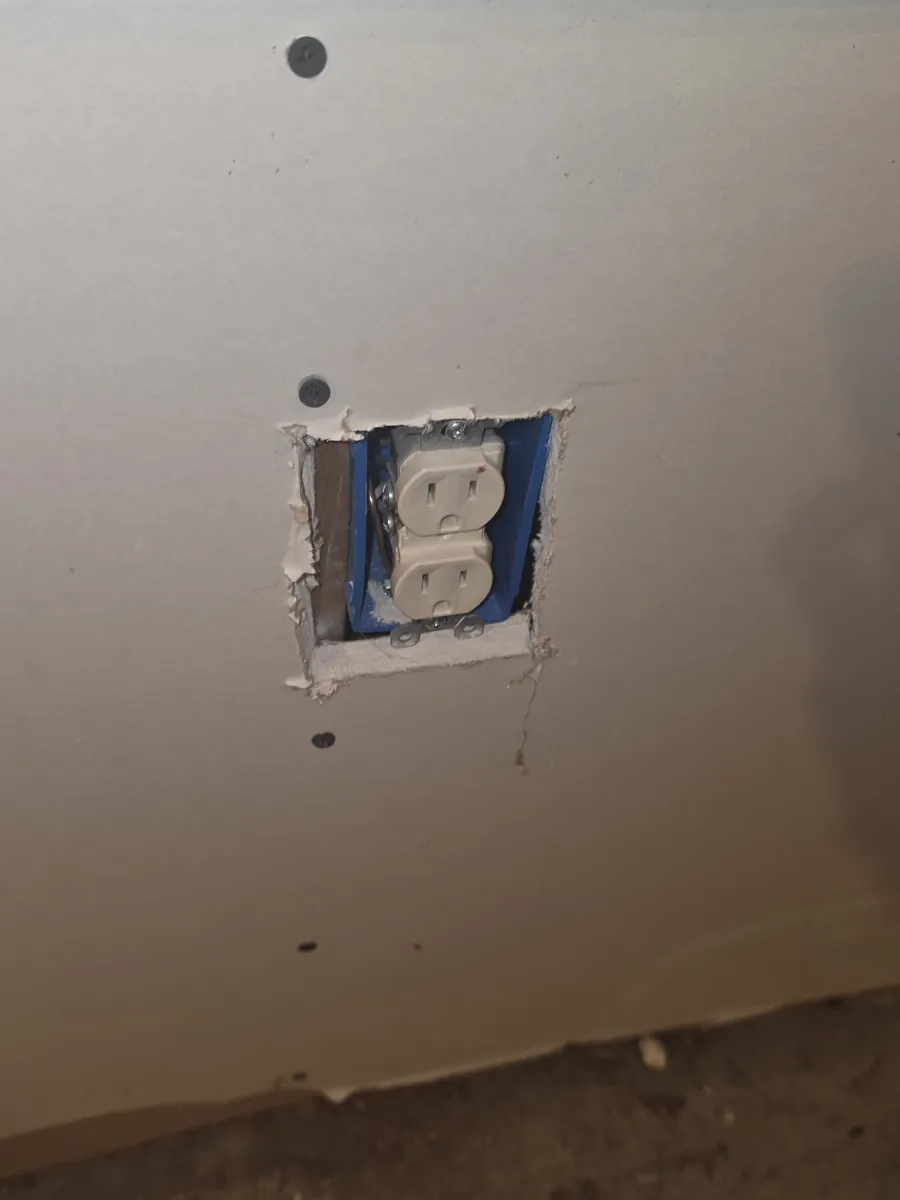
Outlet repair, GFCI outlets and light switches
Most outlet and switch calls are repairs, not new installs: something stopped working, tripped, or got warm. Here is what each one usually means.
Dead outlets
Usually a tripped GFCI somewhere else on the circuit, or a failed connection at the outlet upstream of the dead ones. Check the bathroom, kitchen, garage and outdoor GFCIs first. If none has tripped, the fault is inside a box, and following the circuit finds it faster than replacing outlets.
Warm, buzzing or scorched outlets
Stop using it. Heat and buzzing come from a loose connection or a worn receptacle that no longer grips the plug. A tiny, brief spark as a plug goes in can be normal; a scorched faceplate or a smell of hot plastic is not.
GFCI outlet installation
A ground-fault outlet cuts the power in a fraction of a second when current leaks to ground, which is what makes water and electricity survivable. The code wants them in kitchens, bathrooms, garages, basements, laundry areas and outdoors. One that will not reset, or trips for no reason, is either worn out or protecting a real fault downstream, and we find which.
Light switches, dimmers and smart switches
Light switch installation is quick where the box and the wiring are sound. Dimmers have to match the bulbs: LEDs want an LED-rated dimmer or they flicker and hum. Most smart switches need a neutral in the box, which older switch loops do not have.
240 volt outlet installation
Dryers, ranges, welders, compressors, shop heaters and EV chargers all run on 240 volts, and each one needs its own circuit sized to its nameplate. The outlet is the easy part; the circuit behind it is the job.
Dryer and range outlets
A dryer is usually a 30 amp circuit and a range a 40 or 50 amp one. Older Kansas City houses often have the three-prong kind with no separate ground; new ones have been four-wire since the 1996 code. If a new appliance came with a four-prong cord and the wall has three, the answer is a three-wire cord on the appliance, which the code allows on an existing circuit, or a new four-wire circuit. Never an adapter.
Garage and workshop outlets
Welders, air compressors and shop heaters each need a circuit sized to what is on the nameplate. The code editions differ here: Independence, on the 2023 NEC, requires ground-fault protection on 240 volt garage outlets; Kansas City, still on the 2017, does not yet.
EV charger outlets
A NEMA 14-50 on a 50 amp circuit is the usual setup for a portable EV charger. The charger draws current for hours at a time, so the code treats it as a continuous load and the circuit is sized with that margin. For a daily driver, a hardwired charger is often the better answer.
Room in the panel
Every 240 volt circuit takes a two-pole breaker: two spaces in the panel and enough capacity left on the service. A full or undersized panel is what most often turns an outlet into a bigger job, so we check it before quoting.
What moves the price of outlet and switch work
We do not publish a dollar figure we cannot stand behind. What we can tell you is which parts of the job move the number.
| Job | Relative cost | What drives it |
|---|---|---|
| Outlet or switch repair | Lowest | A dead, loose or worn device, or the failed connection behind it. Most are found and fixed in one visit. |
| Outlet or switch replacement | Baseline | Swapping a tired receptacle or switch, or adding GFCI protection where a plain outlet is now. |
| Adding an outlet on an existing circuit | Higher | A new box and a run to the nearest source. Drywall and access decide it, not the outlet. |
| Outdoor receptacle | Higher | An in-use weatherproof cover, GFCI protection, and getting through the wall cleanly. |
| A new circuit from the panel | Highest | For a garage freezer, a workshop, a window unit or anything that trips the breaker today. Distance and panel capacity drive it. |
| A 240 volt outlet | Priced by the run | A dryer, range, welder, compressor or EV outlet on its own two-pole breaker. The distance from the panel and the space left in it decide it. |
| Smart switches and dimmers | Depends on the wiring | Most need a neutral at the switch. Older switch loops often do not have one. |
We look at the box, the circuit and the access before quoting, then give a flat price.
What to Expect
Find out what is actually there
Whether the circuit has a ground, what else is on it, and whether the box is sound. That decides the job.
Flat price first
Including the patching if a wall has to be opened.
Install on screw terminals
Devices landed properly, grounded, and the box made up so the next person can work in it.
Test every one
Polarity, ground, and GFCI trip test. We leave the circuit labeled if it was not.
Questions We Get
Why did my outlet stop working?
Most often a failed connection rather than a failed outlet: a back-stabbed receptacle upstream that has lost its grip, a loose neutral, or a tripped GFCI somewhere else on the circuit. Everything downstream goes dead at once, which is the giveaway. Finding it is quick when you follow the circuit instead of replacing parts.
How much does outlet installation cost?
Replacing a device is the smallest version. Adding a new outlet depends on how far it is from a source and what the walls are like. A brand new circuit from the panel is the biggest version, and that one depends on your panel having room. We quote it flat, after looking.
Do I need GFCI outlets?
In kitchens, bathrooms, garages, basements, laundry areas and outdoors, yes — that is what the code requires, and it is the cheapest safety upgrade in a house. Which exact locations depends on the code edition your city enforces.
How high should an outdoor outlet be?
The electrical code asks for at least one outdoor receptacle at the front and back of a house, reachable from the ground and no more than 6½ feet above grade. Within that, we put it where you will actually use it and high enough to stay clear of snow and splash.
Do outdoor outlets need a special cover?
Yes. An outdoor receptacle in a wet location needs an in-use cover, the bubble-style cover that stays weatherproof with a cord plugged in, and it needs ground-fault (GFCI) protection. Many outdoor outlets that trip or die are simply missing one or the other.
Can you add an outdoor outlet?
Yes, with an in-use weatherproof cover and ground-fault protection. The part that takes the thought is where it goes: close to what you actually plug in, and through a wall cavity we can reach cleanly.
Why won't my GFCI outlet reset?
Either no power is reaching it, often because another GFCI or a breaker upstream has tripped, or it is sensing a real ground fault in something plugged into it or wired after it, or the device itself has worn out. Unplug everything on it and try again. If it still will not reset, it needs a look rather than another press.
Can you install a dimmer for LED lights?
Yes. The dimmer has to be rated for LED loads and the bulbs have to be dimmable; a dimmer built for incandescent bulbs is the usual reason LEDs flicker, buzz or will not dim all the way down.
My smart switch will not work. Why?
It probably needs a neutral conductor at the switch, and older switch loops frequently do not have one. There are switches designed around that, and there are situations where running a neutral is the honest answer.
How much does it cost to install a 240 volt outlet?
It comes down to four things: how far the outlet is from the panel, the size of the circuit (a 50 amp run uses much heavier wire than a 30 amp one), finished walls in the way, and whether the panel has two spaces and the capacity left. With a panel close by and room in it, it is one circuit, one breaker and one receptacle. We quote it flat after looking at the panel and the route.
Can you add a 240 volt outlet in my garage?
Yes. Tell us what it is for, a welder, a compressor, a heater or an EV, because the nameplate sets the breaker, the wire and the receptacle. In cities on the newer code editions, Independence among them, a 240 volt garage outlet also needs ground-fault protection.
Do you replace two-prong outlets?
Yes, and the right fix depends on whether there is a ground. With a ground available, a three-prong outlet is straightforward. Without one, the code answer is a GFCI device labeled as having no equipment ground, or running a proper grounded circuit. We will tell you which applies rather than just swapping the face.
Ready to Get Started?
Call or request a free quote online. Emergencies get answered any hour, and we usually answer quote requests the same day.