New Construction Electrician
Wiring a new house or an addition is a different job from fixing one. The work happens in two visits months apart, it has to land between the framer and the drywall crew, and most of it disappears behind the walls. What you are really buying is the part nobody sees again.
Rough-in, then trim-out
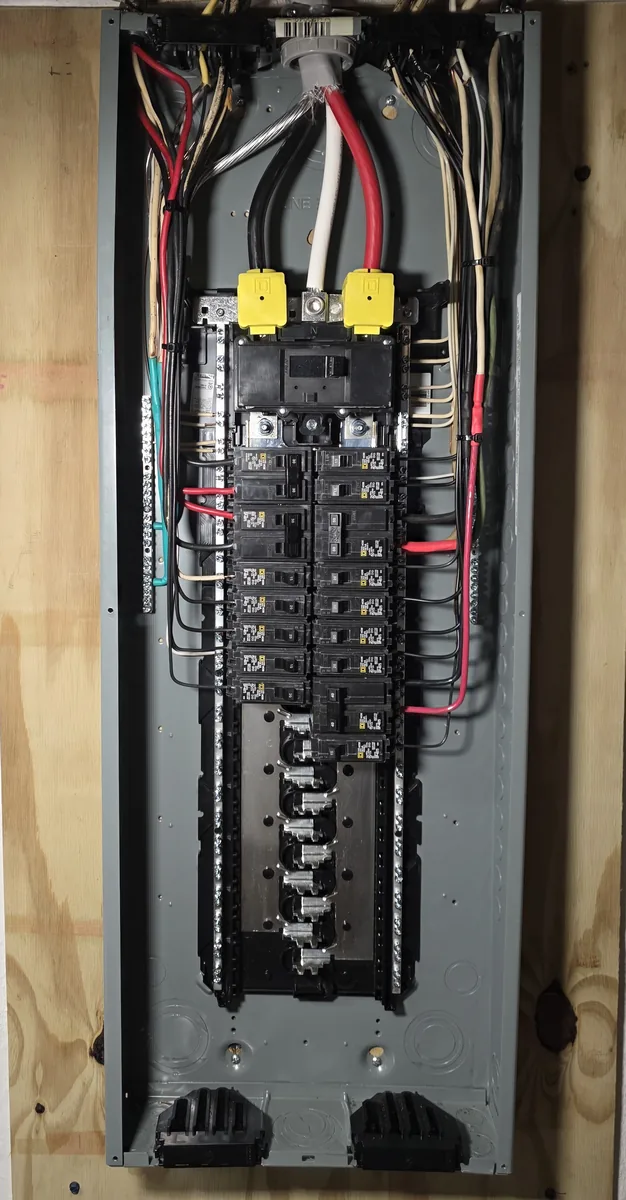
Electrical on a new build comes in two passes. The rough-in happens once the frame is up and the roof is on, usually after plumbing and heating have claimed their space: boxes set, circuits run, the service and panel established, and everything left open for the inspector. Once that passes, insulation and drywall close the walls. The trim-out comes at the end, when devices, fixtures and covers go in and the panel is labelled and tested.
We are a crew of four to five, so a new build is something we take one at a time. That is the trade: no production-builder volume, and no hand-off to a crew you have not met.
The value is decided at rough-in, not at trim. Where the outlets land, how many circuits the kitchen gets, whether the garage has a spare circuit and room in the panel for an EV charger later, whether the lighting is switched the way people actually walk through a room. Changing any of it after drywall costs real money, so we walk the plan with you before anything is run.
What moves the price of new construction wiring
We do not publish a dollar figure we cannot stand behind. What we can tell you is which parts of the job move the number.
| Job | Relative cost | What drives it |
|---|---|---|
| An addition on an existing house | Baseline | Circuits for the new space, tied back into the existing panel. Whether the panel has room is the first thing we check. |
| A detached garage or shop | Moderate | A feeder out to the building, a subpanel, and the trench. Distance and what you plan to run out there decide it. |
| A whole new house | Project | Rough-in and trim-out priced together, by the size of the house, the fixture count and the service. |
| Service and panel for a new build | Included in the project | Sized for how the house will actually be used, with room for later: EV charging, a shop, a hot tub. |
| A panel upgrade the addition forces | Added cost | Common on older houses. An addition on a full panel means the service gets addressed first. |
We price new work from the plan, or from a walk-through for an addition, and give a flat number before anything starts.
What to Expect
Walk the plan
Outlets, lighting, circuits and the service size, agreed before anything is run.
Rough-in on schedule
After framing, plumbing and heating. We work to the builder's dates, not our own.
Inspection before the walls close
Permit pulled, inspector met, corrections handled on the spot where we can.
Trim-out and label
Devices, fixtures, covers, and a panel labelled so the next person can read it.
Questions We Get
How big a job can you take on?
We are a family crew of four to five, which suits one house, one addition or one shop at a time rather than a street of them. The upside is that the people who priced your job are the people wiring it, and you are not handed to a different crew halfway through.
Do you work with builders or only homeowners?
Both. We wire new houses for builders and take additions, garages and shops directly for homeowners. On a builder's job we work to their schedule and their inspector; on a homeowner's job we handle the permit and the inspections ourselves.
When does the electrician come in on a new build?
Twice. The rough-in happens after the frame and roof are up and after plumbing and heating have run their lines, and it has to be inspected before insulation and drywall. The trim-out is near the end, when the devices and fixtures go in.
What is an electrical rough-in?
Everything that ends up behind the wall: the boxes, the circuits run back to the panel, the service and panel themselves, and any conduit for what comes later. It is inspected open, before the walls are closed, because after that nobody can see it.
Can you wire an addition into my existing panel?
Usually, if the panel has spare capacity and spare slots. Plenty of older panels have neither, and then the honest answer is that the service gets upgraded first. We check that before quoting the addition, so it is not a surprise halfway through.
Do you pull the permit for new construction?
Yes. Electrical permits in Kansas City are pulled by the licensed contractor, not the homeowner, and we meet the inspector at both the rough-in and the final. Which code edition applies depends on the city: Kansas City enforces the 2017 NEC, Independence the 2023.
Can you rough in for an EV charger or a shop I will add later?
Yes, and it is much cheaper now than later. A conduit run to the garage and spare capacity in the panel cost very little while the walls are open. We will ask what you might add in the next few years before sizing anything.
Ready to Get Started?
Call, text, or request a free quote online — we typically respond within one business day.